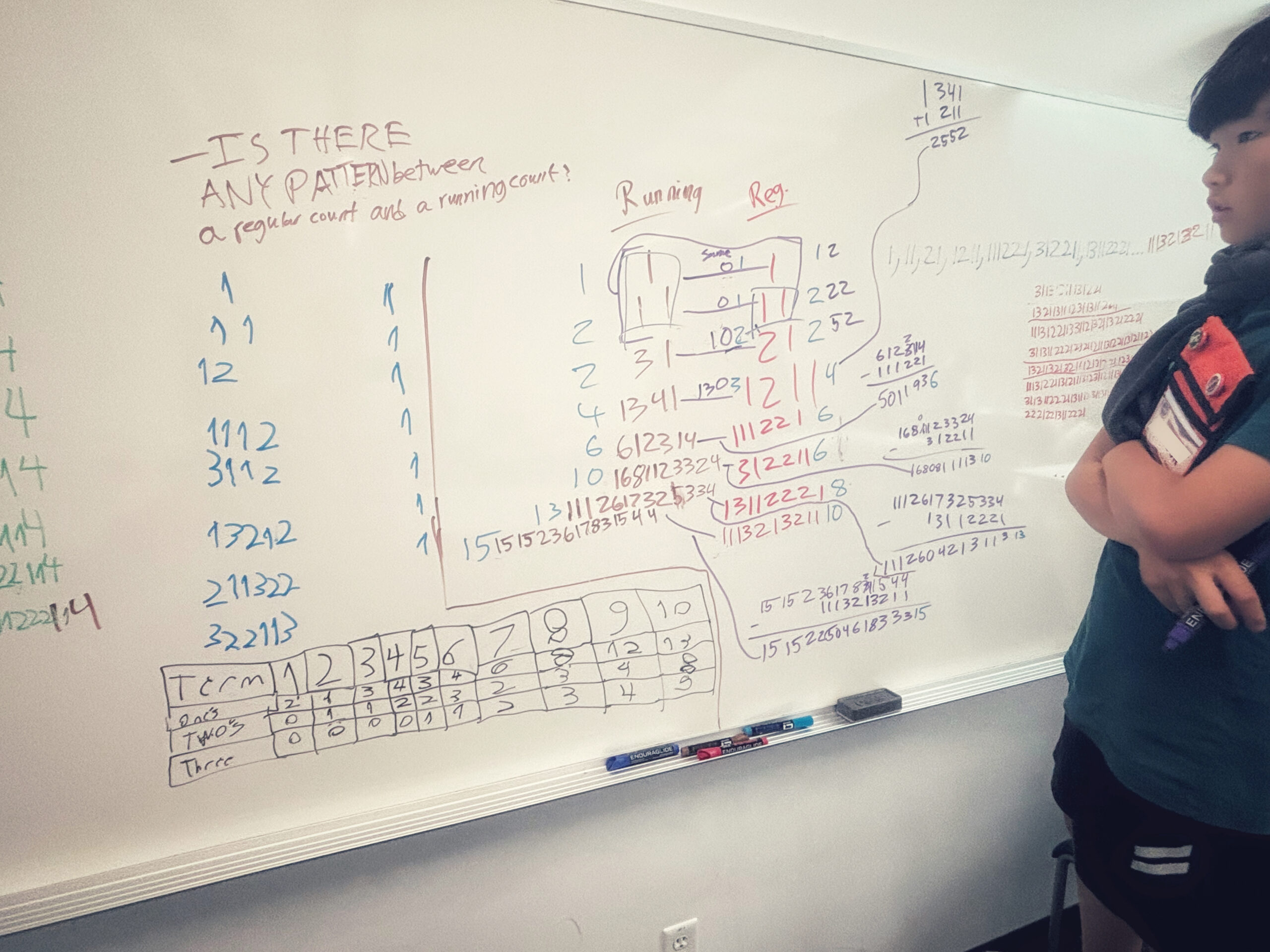

The Math Exploration Problems are a key part of our application process for Camp Conway & Camp Sierpinski. They’re designed to give us a window into how your student thinks about challenging mathematical ideas.
However, we also understand that the Exploration Problems (and the application process in general!) can be stressful for both students and their parents. Below are some suggestions to help create an environment where your student can do their best work, without unnecessary stress.
Want a general overview of our application process? You can find it in the “How to Apply” section of each camp page.
Ensure they have enough time and space
Once you start the timer on our application platform, you’ll have 48 hours to submit your student’s work. We encourage students to spend about 1–2 hours on each of the two parts, including writing up their solutions, and to take a break in between. Choosing a start time that allows for this—often a weekend—can help them feel less rushed.
We recommend:
- Giving your student Part 1 first, then allowing a real break before starting Part 2.
- Making sure they’re mentally ready to jump back into challenging math before continuing.
- Clearing off a workspace so they have plenty of room and as few distractions as possible.
Take steps to reduce anxiety
It’s helpful to set expectations early that these problems are meant to be challenging—even for very strong students—and that we don’t expect anyone to solve everything. What matters most to us is your student’s thought process and engagement. Partial solutions, creative ideas, and approaches that didn’t quite work are all valuable.
For students who are used to always finishing every problem they’re given, this can be a difficult adjustment.
While we recommend spending 1–2 hours on each part, the only strict time limit is that you submit within the 48 hour window. If your student is a slower thinker, a slower writer, or experiences anxiety around timed work, reassure them that taking more time is completely okay. Speed is not very important to us—after all, mathematicians often spend months, years, or even decades working on a single problem.
Before your student begins, we also recommend reviewing the student-facing instructions and sample problem together so they know what to expect.
Give them plenty of paper and help them organize their work
We strongly prefer handwritten solutions, even if the writing is a bit messy. We want to understand your student’s thought process, and for most students that comes through more clearly on paper, where they can easily draw pictures, add arrows, cross out sections, etc.
While you shouldn’t help with the math itself, you can help your student:
- Keep their work organized
- Check that pages are labeled and in order before submitting
We’re looking for:
- Separate pages for each problem’s solutions (labeled, for example, “Problem 1, Page 1”)
- All scratch work included, even if it’s messy or mixed together (these pages can simply be labeled “Scratch Work”)
- A page labeled “Reflection Questions”, with those questions answered
Submitting an optional video explanation
In some cases, families choose to submit a short video (under 5 minutes) in addition to the written work. This is entirely optional and is only recommended if:
- You’re concerned that your student’s written work may be especially hard to follow (for example, due to handwriting), or
- You know that your student struggles to explain their thinking in writing but communicates more clearly verbally.
The video does not need to be polished or rehearsed. We’re simply interested in hearing your student talk through their thinking and what they explored. Videos are only reviewed if we’re having trouble following the written work.
Help them avoid the temptation to cheat
Students can put a lot of pressure on themselves to do well, and that pressure—combined with easy access to tools like ChatGPT—can make it tempting to seek outside help. Creating a supportive environment with clear boundaries can help reduce that temptation.
We recommend:
- Keeping phones and unnecessary electronic devices out of reach while your student is working
- Minimizing interruptions from siblings or others (especially mathematically inclined ones)
- If a computer is used to view the PDF, turning off internet access, closing unnecessary applications or windows, and keeping the document full screen
A calculator is not necessary, but if your student would prefer to use one, a basic or scientific calculator is fine. If using a calculator app on a device, we recommend the same safeguards described above.
Feel free to reach out!
If questions come up at any point in the application process, please don’t hesitate to reach out by phone or email. We’re happy to help troubleshoot technical issues, discuss any accommodations that may be helpful, or clarify logistics and expectations.