Camp Conway
Unleashing curiosity, creativity, and the spirit of exploration through captivating mathematical adventures.
- Harvey Mudd College, Claremont, CA
- info@nationalmathcamps.org
Camp Overview
Camp Conway is a 2-week residential camp for students aged 11 – 14. It’s named in honor of the mathematician John Horton Conway, who passed away in 2020. Conway had a profound love for summer math programs, and his approach to mathematics was brimming with curiosity, wonder, and playfulness — qualities we strive to nurture in our campers. He was a fearless explorer, driven by what fascinated him in mathematics (and beyond), making deep, original, and often unexpected contributions to multiple fields.
At Camp Conway, students will embark on their own journeys as math explorers — asking questions, forming conjectures, and uncovering mathematical treasures. Along the way, they’ll develop persistence, sharpen their problem-solving skills, deepen their mathematical understanding, and be inspired by a wealth of challenging and captivating mathematics.
Camp Dates & Location
Location: Harvey Mudd College, Claremont, CA
Session 1: 6/21/2026 - 7/3/2026
Session 2: 7/5/2026 - 7/17/2026
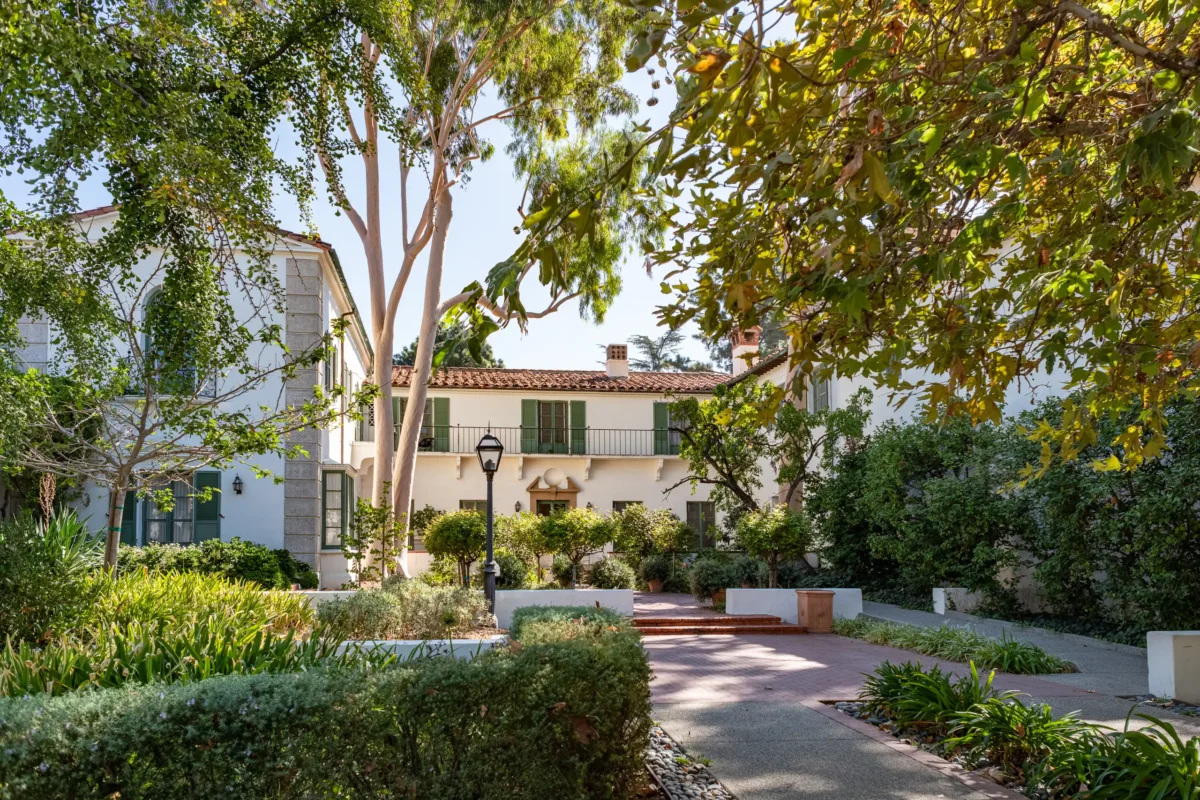
Located at Harvey Mudd College, Camp Conway places students in a iconic setting for mathematical learning. And as part of the larger Claremont Colleges campus community, students will have access to private dormitory housing and community spaces at adjacent Scripps College, voted #1 best campus living in the U.S. by Princeton Review. The location and southern California weather offer plenty of outdoor learning and recreation opportunities for active campers in a secure and serene setting.
Dates don’t quite work? Prefer the east coast? Check out Camp Sierpiński!
Application deadlines
Applications for new students are now open! Join our mailing list to be notified of upcoming deadlines.
We review applications in several rounds. Early applicants receive priority consideration and access to discounted tuition. After the regular admissions deadline, we will continue to review applications on a rolling basis if space is still available.
Early Round 1: 2/1/2026
Early Round 2: 3/1/2026
Regular: 3/29/2026
What We're Looking For
Camp Conway is designed for students ages 11–14 as of June 1, 2026, regardless of grade level. Below is what we look for in students who will flourish in our community.
Strong Interest in Math:
Students who thrive at NMC are deeply curious about mathematics and enjoy thinking about ideas beyond the classroom. They love exploring challenging problems, asking “what if?” questions, and sometimes spending hours — or even days — unraveling a single idea. They’re excited by the prospect of doing math for much of the day for two weeks, and they look forward to being surrounded by other kids who share their enthusiasm and want to dive deeply into big, beautiful mathematical ideas.
Math Knowledge & Problem-Solving Skills:
Since school math curricula vary widely across the country and globe, we use Art of Problem Solving (AoPS) as our reference point when describing prerequisites. Our main mathematical prerequisite for Camp Conway is completion of AoPS Prealgebra or an equivalent curriculum. You can take this test to determine if you have mastered the prerequisite content. Please don’t overlook the geometry, counting/probability, and problem solving questions — these topics are often not emphasized in other prealgebra curricula but are important for our camps!
We’ve also found that the comfort with linear equations gained in an introductory algebra course, such as AoPS Introduction to Algebra, can be very helpful.
Has your student progressed well beyond the level of introductory algebra? Don’t worry! This is common in our community, and our camps are designed to challenge these students too — there is so much deep, beautiful, and exciting mathematics to explore!
Residential Camp Readiness:
At NMC, our mission goes beyond simply teaching mathematics. We strive to create a supportive, enriching residential environment that meets the unique social-emotional needs of mathematically gifted children. Campers spend two intensive weeks living, learning, and playing together, which can be both exciting and challenging. Many gifted students experience distinct emotional, intellectual, and social dynamics, and being away from home (especially while surrounded by peers for long days of activities!) requires a level of readiness for independence, connection, and flexibility.
To ensure every camper is supported throughout this experience, each camp includes a Camper Support Director on the leadership team. This role is held by a trained professional with deep experience supporting gifted and twice-exceptional (2e) students in residential and school settings. The Camper Support Director provides compassionate, individualized guidance during camp life and partners closely with families to help students feel safe, understood, and comfortable navigating both the academic and social aspects of camp. Their presence helps ensure that each camper can flourish — socially, emotionally, and academically.
You can read more about our approach here.
A Typical Day
Campers will attend classes five days each week, and will spend about six hours each day doing mathematics, with plenty of breaks throughout. Our daily schedule will include:
Topics Classes
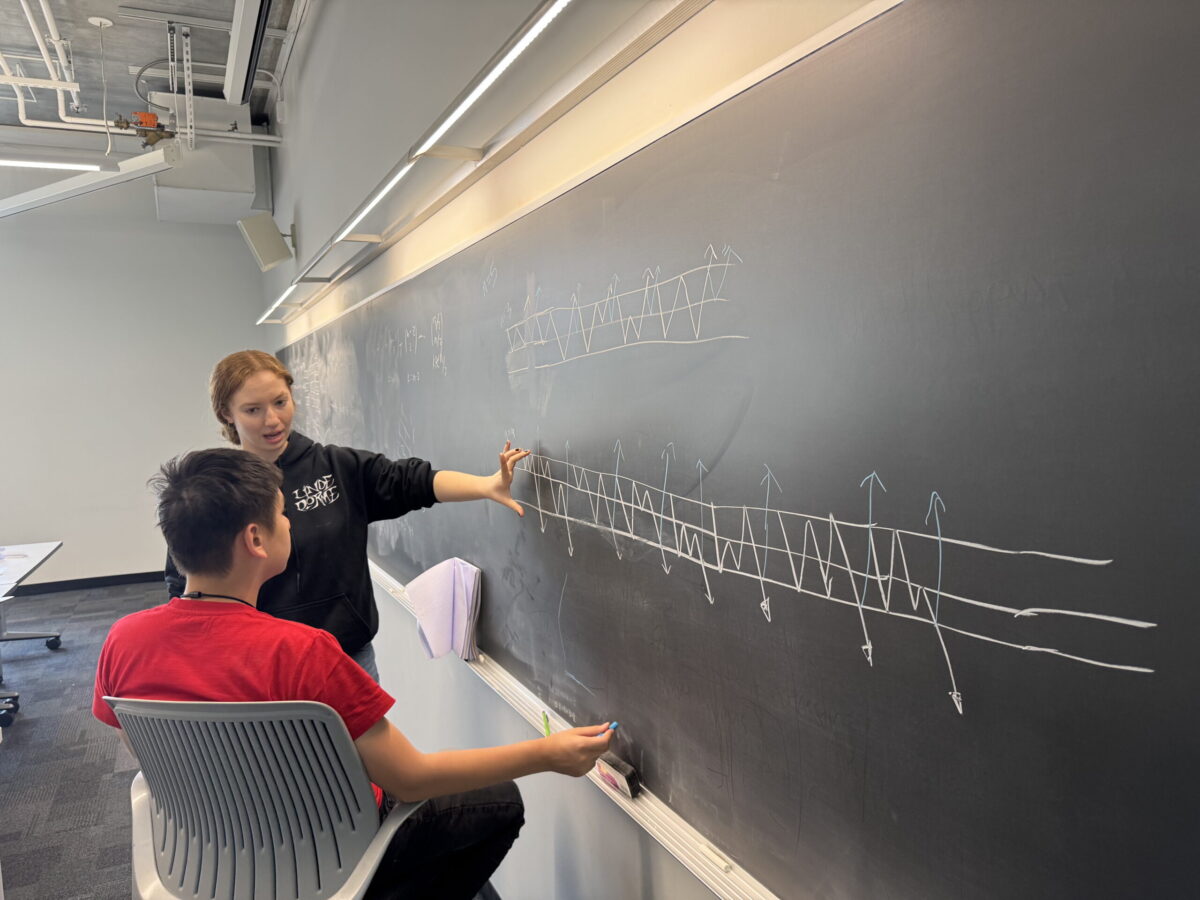
Students will take a different Topics Class each week, which will meet twice per day. These classes are designed to allow students to dive deeply into an area of math. Topics classes are active, exploratory, and student-driven, with lots of room for unexpected detours. The topics that are offered vary session-to-session and year-to-year, as they depend on the interests and expertise of our faculty. However, potential topics could include graph theory, group theory, combinatorics, infinity, number theory, cryptography, knot theory, coding theory, voting theory, partitions, combinatorial games, projective geometry, and more! You can find sample course descriptions from previous years here.
Math Explorations Class
All students will participate in our signature Math Explorations class, designed to teach them what it truly means to be a mathematician. Being a mathematician goes beyond solving problems posed by a teacher — it’s about learning to ask your own questions and exploring them deeply. In this class, students will engage with the full mathematical process: from formulating their own questions to exploring solutions, writing up their findings, and presenting their results. Along the way, they’ll sharpen their problem-solving and communication skills, while also building persistence and a deeper appreciation for the beauty of mathematics.
Morning Assembly
After some quick announcements, our morning assemblies will generally feature an interactive math lecture or other activity. These are designed to widen students’ mathematical horizons, exposing them to many new types of math. Most of these will be delivered by our faculty, but we also expect to have a guest or two each session!
Open Math Time
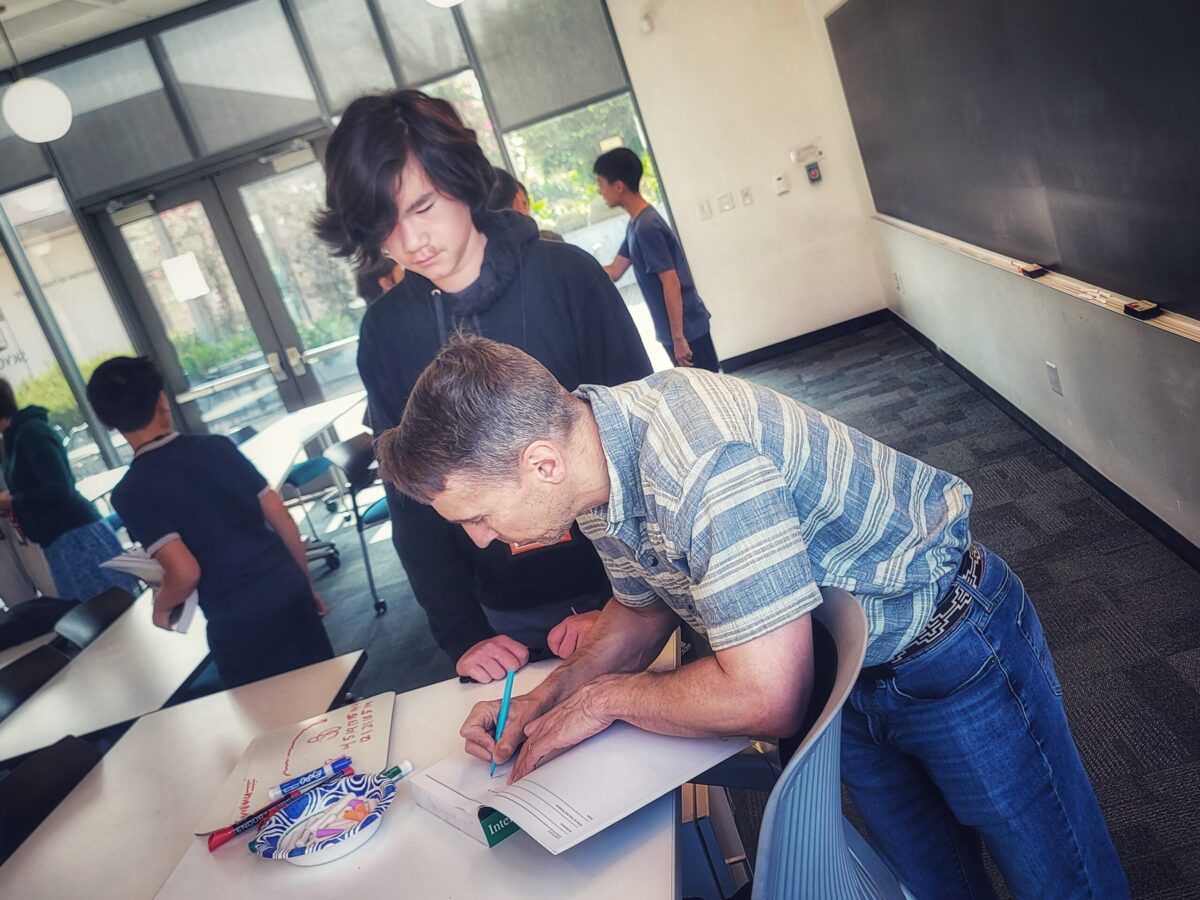
During this self-directed time, students can chat with faculty, dive deeper into ideas that sparked their curiosity that day, or drop in on staff-led math challenges, puzzles, short talks, and hands-on activities.
Activity Periods
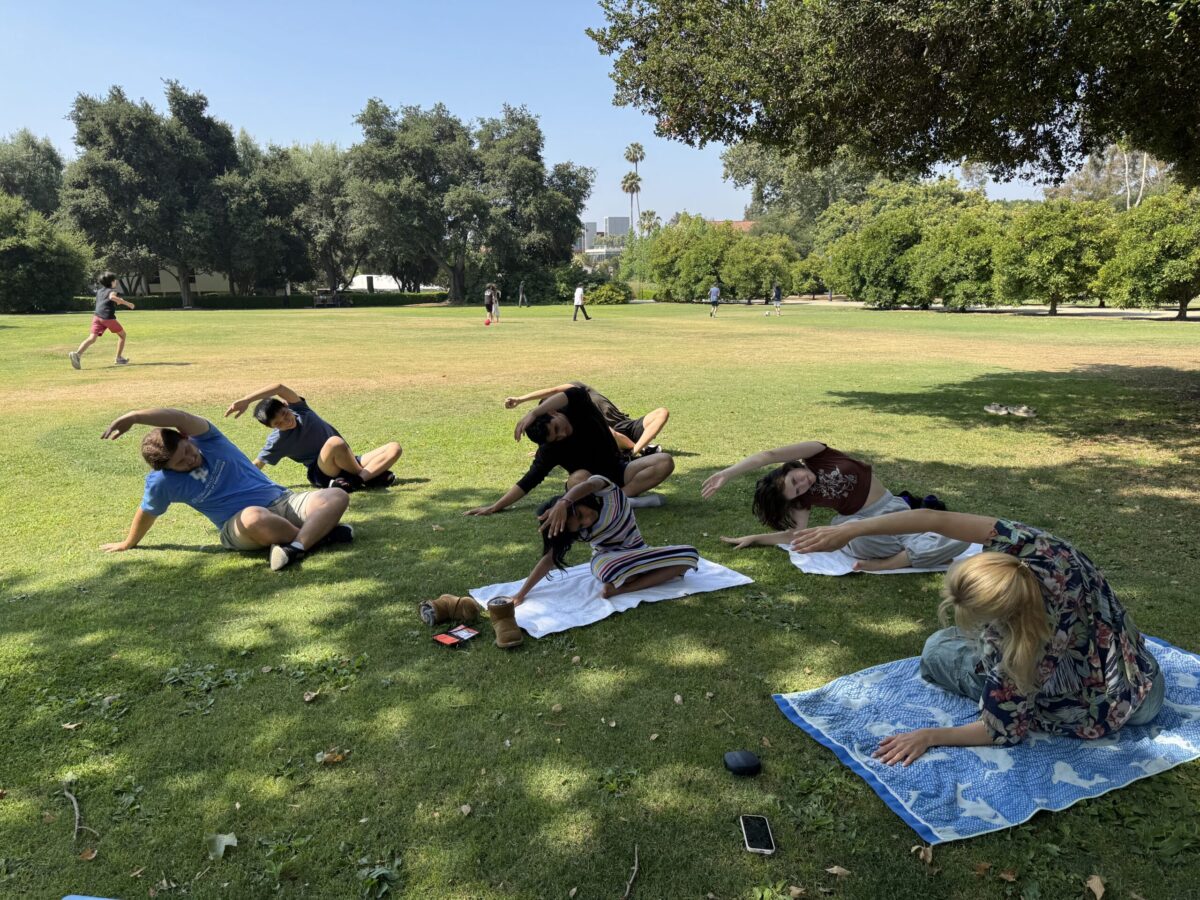
Twice each day, we’ll have activity periods with multiple options for campers to choose from, such as board games, origami, karaoke, ultimate frisbee, soccer, etc. Activity options will vary day-to-day and be based on the interests of our campers and staff.
Other Activities
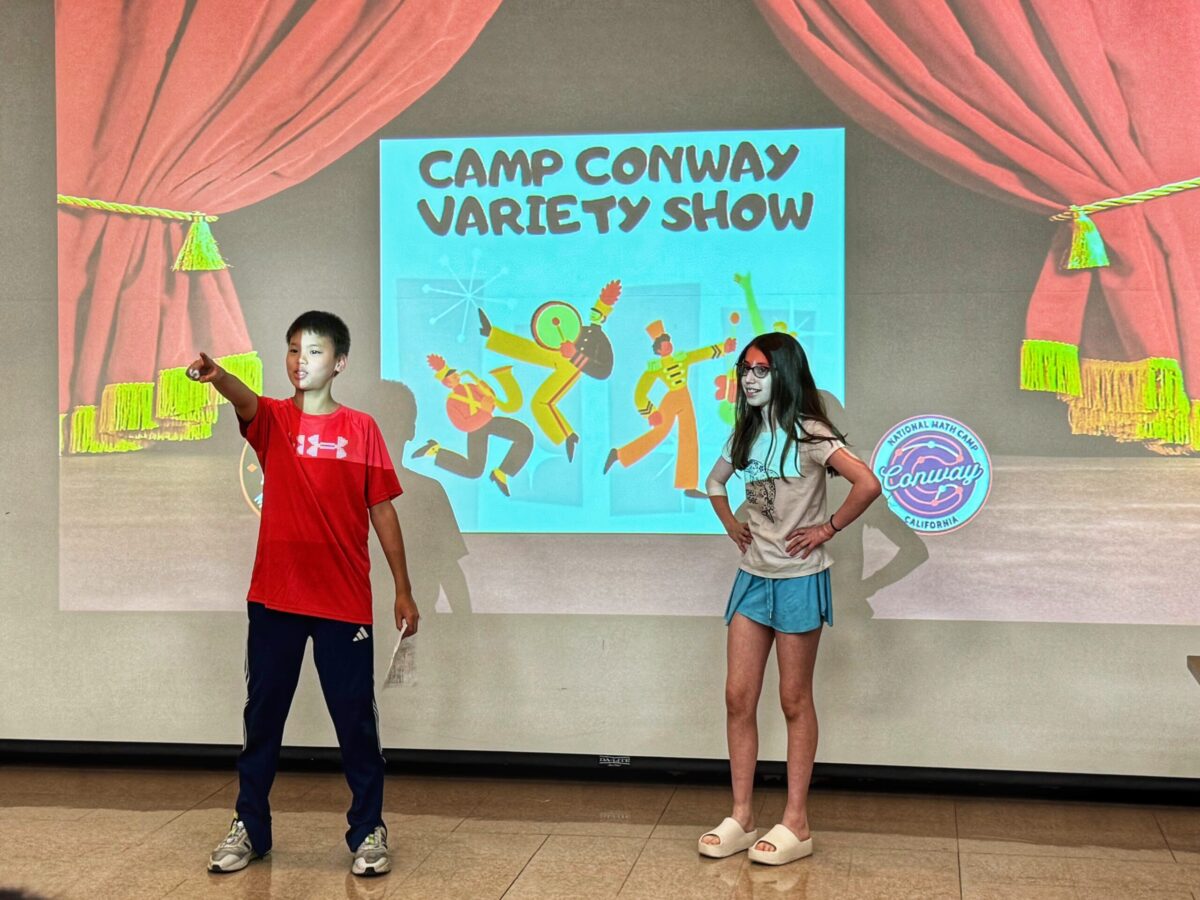
On days when we don’t have class, campers will participate in a mix of mathematical and recreational activities, such as team competitions and challenges, a camper-led variety show, and maybe even a field trip! These activities are meant to build community, foster friendships, and make lasting memories.
Want an even better sense of what camp is like?
How to Apply
Applications for new students are now open! Join our mailing list to be notified of upcoming deadlines.
A single application allows you to apply to both Camp Conway and Camp Sierpiński. You’ll indicate your program preferences in the application form.
We review applications in several rounds. Early applicants receive priority consideration and access to discounted tuition. After the regular admissions deadline, we will continue to review applications on a rolling basis if space is still available.
Application Timeline
| Application Round | Application Deadline | Recommender Deadline | Receive Decision By |
|---|---|---|---|
| Alumni Only | Dec 31 | N/A | End of Jan |
| Early 1 | Feb 1 | Feb 8 | End of Feb |
| Early 2 | Mar 1 | Mar 8 | End of Mar |
| Regular | Mar 29 | Apr 6 | End of Apr |
Application Checklist:
- Initial Application
- Main Application
- Student Short Answer Form
- Two Recommendations
- Math Exploration Problems
Initial Application:
This initial application includes some basic info about your student and a short math self-assessment for them to complete. This will give you a good sense of whether they are mathematically ready for our camp before diving into the rest of the application.
Main Application:
The main application includes parent short answer questions, recommendation information and camp/session preferences. It also allows you to trigger an email to your mathematical recommender to complete the recommendation form and to your student to complete the student short answer form.
Student Short Answer Form:
While most of the application is completed by the parent, this is where we want to hear directly from the student applicant!
Recommendations:
In most cases, two recommenders are required: one mathematical and one non-mathematical.
The mathematical recommender should be a math teacher, math coach, or another adult who knows the student well in a mathematical setting. They will receive a short online form to complete. As shown in the chart above, there is a one-week grace period for the recommendation to be completed after the relevant application deadline.
The non-mathematical recommender should be an adult who regularly interacts with the student in an in-person group setting, such as a teacher, club advisor, athletic coach, or scout leader. They do not need to complete an online form — we’ll reach out to them only if we need additional information.
Please note that recommenders cannot be parents or close relatives.
If the student attended another in-person math summer program this past summer, we may be able to skip the normal recommendation process and instead just reach out to that program directly. Programs we can currently do this with include: Bard Math CAMP, BEAM Summer Away, Campersand (C&!), Epsilon Camp, Mainline Classical Academy Summer Math Camp, Math in the Mountains, Mathpath, Orlando Math Circle Summer Mathematics Leadership Institute & Summer Camp.
Math Exploration Problems:
After submitting the main application form, you will gain access to the Math Exploration Problems. Once you click to start the timer, you must upload a PDF with the student’s work within 48 hours. We recommend planning for your student to spend 1 – 2 hours on each of the two parts. For guidance on how to set your student up for success, please see our blog post here.
Tuition & Financial Aid
Tuition:
Tuition for Camp Conway ranges from $3,995 to $4,295, depending on the application round. We offer generous need-based financial aid, including awards that cover up to 100% of tuition plus travel costs.
Tuition includes all camp-related expenses: room and board, educational materials, recreational activities, and full access to our expert faculty.
To receive the discounted tuition associated with your application round, you must enroll within two weeks of receiving your acceptance.
We also offer flexible payment options to make planning easier for families. You may pay in full at the time of registration or select a payment plan with installments. Detailed payment instructions will be provided upon registration.
Refund Policy: We understand that plans can change. Families who withdraw on or before April 30th will receive a refund of tuition minus a $200 administrative fee. After April 30th, tuition is non-refundable.
Conway Tuition by Application Round
| Application Round | Application Deadline | Full Tuition* |
|---|---|---|
| Alumni Only | Dec 31 | $3,995 |
| Early 1 | Feb 1 | $4,095 |
| Early 2 | Mar 1 | $4,195 |
| Regular | Mar 29 | $4,295 |
| Rolling | N/A | $4,295 |
*Many campers attend free or at greatly reduced cost. See the financial aid table below — and please don’t hesitate to reach out if finances are a concern!
Financial Aid:
NMC is committed to making our summer camp experiences accessible to all qualified students. We offer need-based financial aid, up to 100% of tuition and travel costs. Our admissions process is need-blind; financial aid is reviewed only after a student receives an offer of admission. The financial aid application is short and simple — usually requiring just the first page of your most recent tax return.
For a breakdown of tuition assistance by annual family income, please click the link below. We are able to guarantee financial aid at the levels shown in the table for all qualifying families, regardless of when they apply. Families with extenuating circumstances are welcome to include additional details for consideration.
Please note that financial aid is not available to international students.
Faculty & Staff
Summer 2026 Camp Leadership
Camp Conway is led by a three-person leadership team. We’ve chosen this model deliberately so that every aspect of the camp experience receives focused attention, and so that students, staff, and families always have a member of the leadership team available when questions or needs arise.
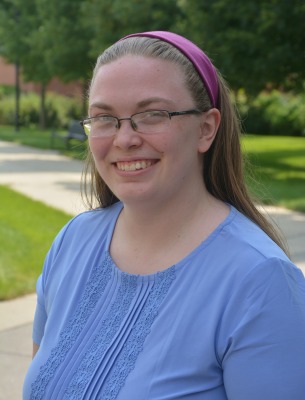
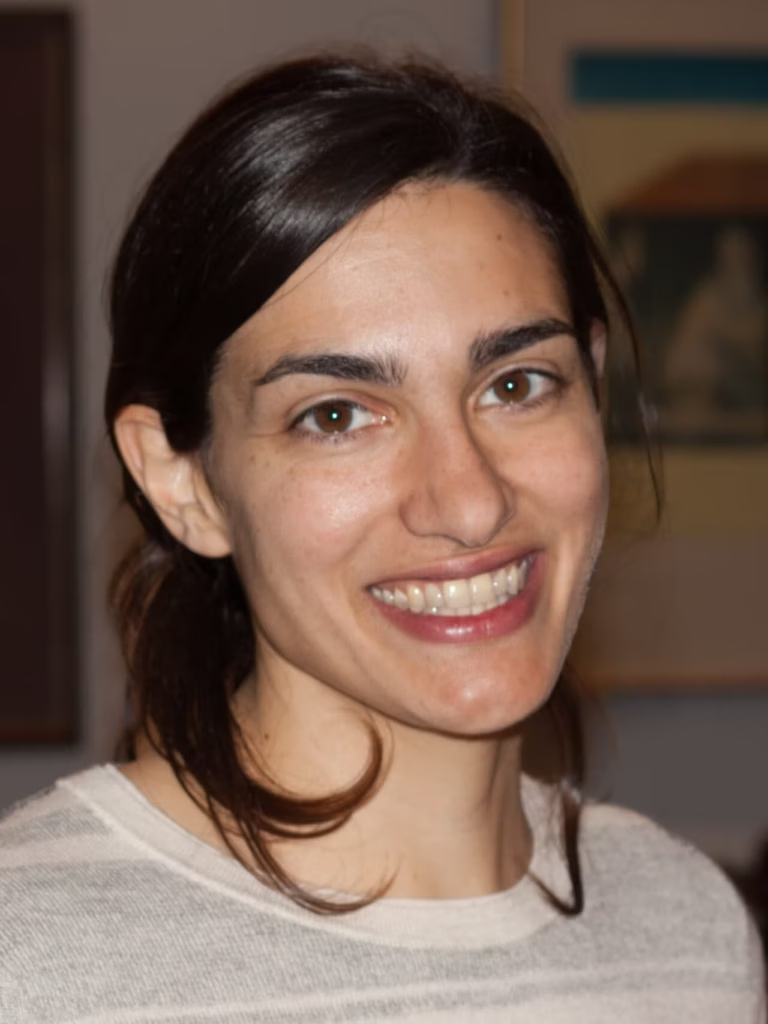
Sarah Trebat-Leder
Academic Director

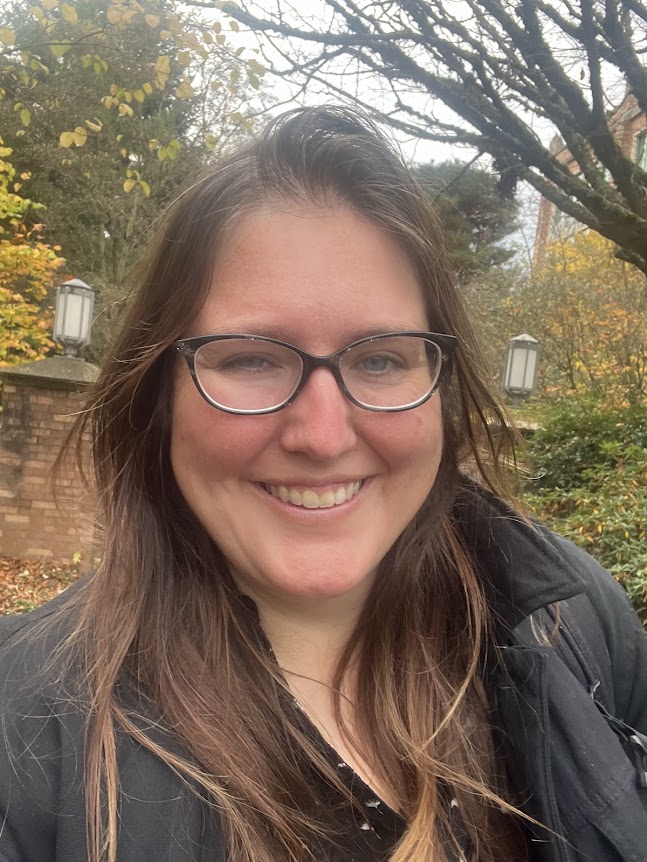
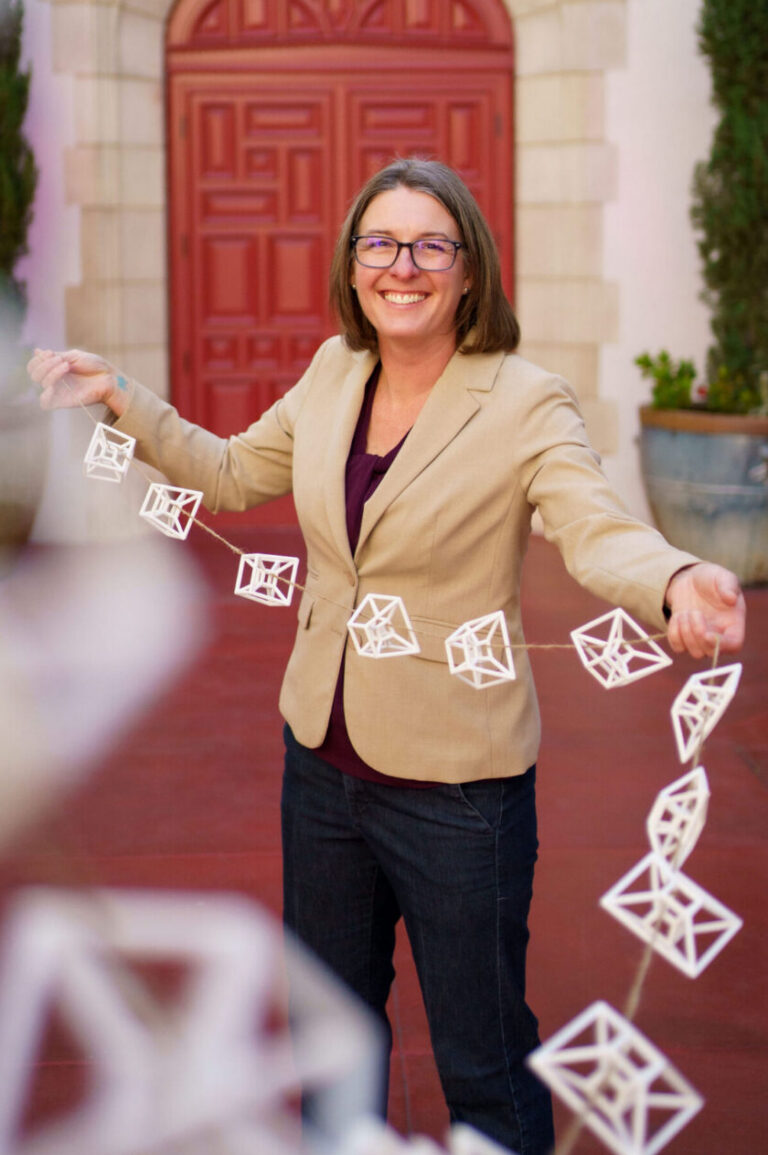
Anne Paoletti
Camp Director
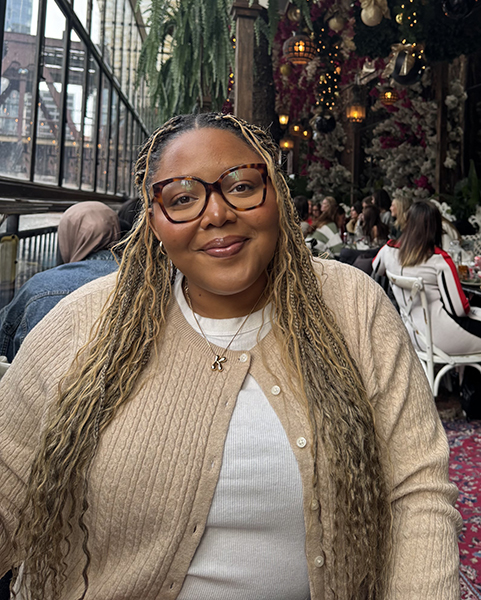
Kennedy Trice
Camper Support Director
SumMer 2025 Camp Staff
We’re thankful to have had an incredible team of passionate mathematicians, educators, and staff for Summer 2025. We’re currently working on confirming our team for Summer 2026. Stay tuned for more details on the amazing individuals who will help bring the Summer 2026 camp experience to life!
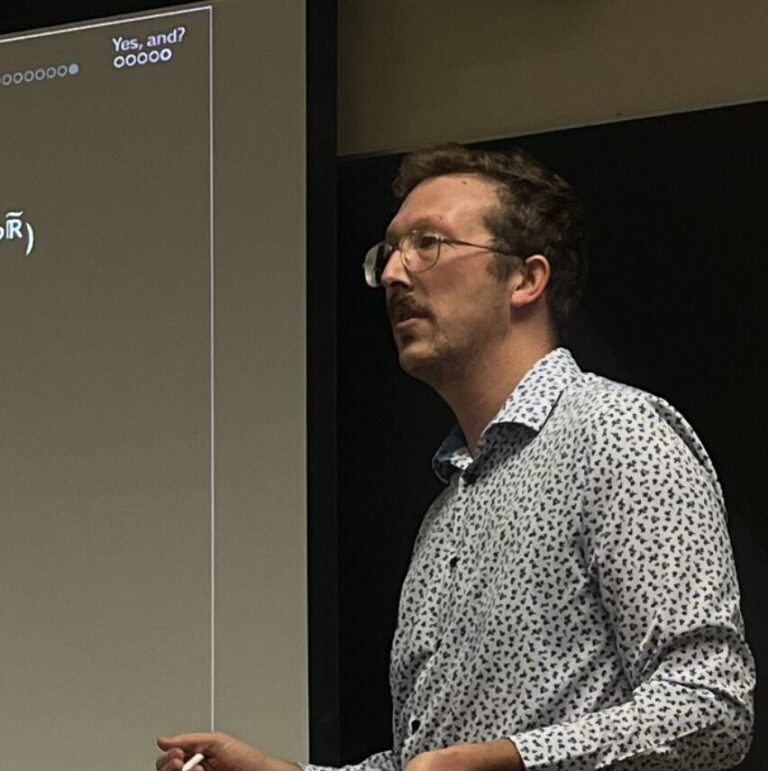
Peter Kagey
Faculty
Read More
Dr. Peter Kagey is an assistant professor in the Department of Mathematics and Statistics at Cal Poly Pomona. His research areas include combinatorics, discrete probability, algebra, and algorithms, along with recreational and experimental mathematics. He is also a mathematical maker who uses 3D printers, laser cutters, pen plotters, and digital techniques to illustrate mathematical ideas.
Peter received his B.S. in Mathematics from Oregon State University in 2014, worked as a software engineer for a medical device company from 2014–2017, and received his Ph.D. from the University of Southern California in 2022. Before Cal Poly Pomona, he was a Visiting Assistant Professor at Harvey Mudd College from 2022–2024.
When he’s not thinking about math, Peter likes cycling, tennis, Tetris, reading, watching slow movies, listening to ambient music, rooting for the Dodgers, and getting meals with friends in his neighborhood of Highland Park in Los Angeles.
Naoki Sato
Faculty
Read More
Naoki Sato is a mathematics curriculum developer at Art of Problem Solving (AoPS). He won first place in the 1993 Canadian Mathematical Olympiad and represented Canada at the 1992 and 1993 International Mathematical Olympiads, winning a bronze and silver medal, respectively. He has also served as deputy leader for the Canadian IMO team in 1997, 2002, and 2006.
A native of Toronto, Canada, Naoki earned a Bachelor’s in mathematics from the University of Toronto and a Master’s in mathematics from Yale University. His interests include the use of technology to enhance the teaching of mathematics.
Kaitlin Tademy
Faculty
Read More
Dr. Kaitlin Tademy (she/her) is a Visiting Assistant Professor at Harvey Mudd College and researches knot theory, the study of mathematical knots (or “spicy circles”, as she sometimes calls them). Kaitlin grew up in Houston, TX. In 2018, she earned her BS in math and a minor in philosophy from Sam Houston State University. She went on to earn her PhD in math from the University of Nebraska in 2024.Kaitlin’s academic background armors her with extensive teaching and mentoring experience. Throughout her academic career, she has been an active participant in the math community—presenting at conferences, sitting on panels, leading inclusive teaching workshops, and mentoring both high school and college students. Her early experiences fertilized her ever-growing passion for accessible math education and whole-student teaching practices.
Outside of math, Kaitlin is an artist and a podcast/audiobook enthusiast.
Alon Amit
Faculty
Alon is a frequent speaker and writer on mathematics, leading math circles…
Read More
Alon is a frequent speaker and writer on mathematics, leading math circles around the Bay Area, and is on the Board of Trustees at Proof School, a San Francisco school for kids who love math. He has also founded a Silicon Valley startup, Origami Logic, which was acquired by Intuit in 2019, and has previously worked at Google, Facebook, and Compugen, a biotech firm. He is now VP of Product at Intuit.
Alon holds a Ph.D. in mathematics and a B.Sc. in Computer Science and Physics From the Hebrew University of Jerusalem, Israel.
Michael Orrison
Faculty
Enrique Treviño
Faculty
Enrique Treviño is a Professor of Mathematics at Lake Forest College, where he has worked…
Read More
Enrique Treviño is a Professor of Mathematics at Lake Forest College, where he has worked since 2013. He completed a PhD in Mathematics at Dartmouth College in June 2011, working with Carl Pomerance. His main research interest is Number Theory, but he has also published in Combinatorics, Probability, and Recreational Mathematics.
He has been very involved in the Mathematical Olympiad, currently working as one of the coaches of the Mexican team (since 2016), but has also coached the Dominican team (2022) and the Canadian team (2017, 2019). He is co-editor in chief of the United States of America Mathematical Olympiad (since 2022).
He enjoys teaching at math camps, teaching at summer math camps most summers since 2015 either at AwesomeMath, the Ross program, or the Ross Asia program.
ARTHUR BENJAMIN
VISITING SPEAKER
Arthur Benjamin earned his B.S. in Applied Mathematics from Carnegie Mellon and his PhD…
Read More
Arthur Benjamin earned his B.S. in Applied Mathematics from Carnegie Mellon and his PhD in Mathematical Sciences from Johns Hopkins. Since 1989, he has taught at Harvey Mudd College, where he is the Smallwood Family Professor of Mathematics and past Chair. In 2000, he received the Haimo Award for Distinguished Teaching by the Mathematical Association of America, and served as the MAA’s Polya Lecturer from 2006 to 2008.
His research interests include combinatorics and number theory, with a special fondness for Fibonacci numbers. Many of these ideas appear in his book (co-authored with Jennifer Quinn), “Proofs That Really Count: The Art of Combinatorial Proof”, published by MAA. In 2006, that book received the Beckenbach Book Prize by the MAA. Professors Benjamin and Quinn were the editors of Math Horizons magazine from 2004 through 2008. He is the 2017 recipient of the Communications Award from the Joint Policy Board for Mathematics.
He has created six DVD courses for The Great Courses on The Joy of Mathematics, Discrete Mathematics, The Secrets of Mental Math, The Mathematics of Games and Puzzles, Math & Magic, and Fibonacci Numbers & the Golden Ratio. He is a past winner of the American Backgammon Tour and is in the American Backgammon Hall of Fame. He is Past President of the Fibonacci Association.
Dr. Benjamin is also a professional magician who performs his mixture of math and magic to audiences all over the world, including the Magic Castle in Hollywood. He has demonstrated and explained his calculating talents in his book “Secrets of Mental Math” and on numerous television and radio programs, including The Today Show, CNN, and National Public Radio. He has been featured in Scientific American, Omni, Discover, People, Esquire, New York Times, Los Angeles Times, and Reader’s Digest. Reader’s Digest calls him “America’s Best Math Whiz.”
Read Less
Richard Rusczyk
VISITING SPEAKER
Richard Rusczyk founded the Art of Problem Solving (AoPS) in 2003 to create interactive educational…
Read More
Read Less
Alissa Crans
Visiting Speaker
Read More
Her research lies in the field of higher-dimensional algebra and has been supported by the National Security Agency and the Simons Foundation. Alissa co-edited “The Mathematical Playground,” a recently published volume celebrating 30 years of the problems column in the MAA undergraduate magazine, Math Horizons.
Outside of math, you can find her working with Guide Dogs of America, running along the Venice Beach boardwalk, or on her quest to find the spiciest salsa on the Westside.
Paul Zeitz
VISITING SPEAKER
Paul Zeitz has been involved in mathematical outreach at every level, from starting math…
Read More
Read Less
Kiran Kedlaya
Visiting Speaker
David Patrick
VISITING SPEAKER
Dr. David Patrick is the Principal Math Curriculum Editor at Art of Problem Solving (AoPS)…
Read More
Dr. David Patrick is the Principal Math Curriculum Editor at Art of Problem Solving (AoPS) and is the author or a co-author of 4 AoPS textbooks. He earned the sole perfect score on the American High School Mathematics Examination (AHSME) in 1988, finished in the top 10 on the Putnam exam in 1991, graduated from Carnegie Mellon with a BS and MS, and has a Ph.D. in mathematics from MIT.
Read Less
FRANCIS SU
VISITING SPEAKER
Francis Edward Su is the Benediktsson-Karwa Professor of Mathematics at Harvey Mudd…
Read More
Francis Edward Su is the Benediktsson-Karwa Professor of Mathematics at Harvey Mudd College and a former president of the Mathematical Association of America. He received his Ph.D. from Harvard University. His research is in geometric combinatorics and applications to the social sciences and he has co-authored numerous papers with undergraduates. He is a Fellow of the American Mathematical Society.
Su also has a passion for teaching and popularizing mathematics. From the Mathematical Association of America, he received the 2013 Haimo Award for distinguished teaching and the 2018 Halmos-Ford Award for his writing. His work has been featured in Quanta Magazine, Wired, and The New York Times.
His book Mathematics for Human Flourishing (Yale University Press, 2020) won the 2021 Euler Book Prize and has been translated into eight languages. It is an inclusive vision of what math is, who it’s for, and why anyone should learn it.
Jessica Jimenez
Camp Nurse
Chloe Ramos
Camp Nurse
Chloe Ramos is a spirited and compassionate registered nurse, certified in public…
Read More
Chloe Ramos is a spirited and compassionate registered nurse, certified in public health nursing, who loves working with the pediatric population and creating a safe, welcoming space for them to grow. She earned her Bachelor of Science in Nursing from California State San Bernardino, working in hospitals, clinics, and community health settings. She started her career on a busy medical-surgical/telemetry unit, where she cared for patients with complex conditions and closely monitored cardiac rhythms and responded to emergencies.
Her journey working with kids started before her nursing career. Chloe spent years as a tutor at Kumon Learning Center, helping young learners ages 3 to 7 build strong foundations in reading and math through engaging tutoring sessions.
In her spare time, Chloe enjoys playing the piano, exploring new coffee shops, visiting flower fields, reading classics, and traveling. This summer, she’s excited to combine her healthcare expertise with her passion for education as a camp nurse at National Math Camps.
Maddie Ravid
Counselor
Maddie Ravid is a rising sophomore at Harvey Mudd College, planning to major in Math…
Read More
Maddie Ravid is a rising sophomore at Harvey Mudd College, planning to major in Math and Physics. She is from the San Francisco Bay Area and loves music—she has played classical piano since childhood and enjoys playing her favorite songs on guitar. She also loves nature, collects plants, built a hydroponic garden, enjoys hiking in California’s beaches and hills, and worked as a camp counselor at an outdoor school for 5th graders.
Maddie is passionate about helping students build confidence and curiosity in math. Before college, she worked as a tutor for two years, participated in a math peer mentoring program at her school, and loved attending her high school’s math club to discuss AMC problems with classmates. She has especially enjoyed her coursework at Harvey Mudd—especially classes like Special Relativity—and is super excited to meet everyone and show them around her college campus!
Mia Leaf
Counselor
Mia Leaf is a rising sophomore at Harvey Mudd College who is planning…
Read More
Mia Leaf is a rising sophomore at Harvey Mudd College who is planning to study math. In high school, she loved participating in math summer programs, including PZ Number Theory Camp, the AwesomeMath Summer Program, HCSSiM, and Canada/USA Mathcamp. At HCSSiM and Mathcamp, she experienced the joy of discovery-based learning, which inspired her to share that joy with others.
She led her school’s math club during her senior year and taught local elementary schoolers through the Claremont Colleges’ Science Bus club. She also enjoys tutoring middle and high school students. When she’s not doing math, Mia plays the trading card game Magic: The Gathering. Math camps have been an inspiring part of her journey, and she’s excited to help create an amazing experience for Camp Conway students this summer.
Shawn Zou
Counselor
Shawn Zou is a rising sophomore at Cornell University, double majoring in Math…
Read More
Shawn Zou is a rising sophomore at Cornell University, double majoring in Math and Computer Science. In high school, he was a 3-time AIME qualifier, won 1st place in the New Jersey Math League, and led his FTC Robotics team to the Worlds Competition as captain and lead coder. He has tutored many students in various STEM subjects and mentored both middle and high school students in chess and robotics.
At Cornell, Shawn is an avid chess player and a member of the Cornell Chess Team A. He also enjoys Sudoku and video games. He’s excited for Camp Conway this summer—not only because it’s his first time visiting California, but also because he’s looking forward to connecting with the next generation of world-changing mathematicians and contributing to a vibrant math community where peers push each other forward.
Eli Sri Rangaraja
Counselor
Eli Sri Rangaraja is a rising sophomore at the University of Michigan…
Read More
Eli Sri Rangaraja is a rising sophomore at the University of Michigan, majoring in Pure Mathematics and Philosophy. He discovered his passion for teaching while leading math and computer-aided modeling classes at CREA, an NGO in rural Nicaragua. He values connecting personally with each student and helping them grow. Outside of math, Eli enjoys 3D printing, woodworking, and playing chess.
Austin Fessler
Senior Counselor
Austin Fessler is a recent graduate of the University of Kentucky, where he earned a Bachelor…
Read More
Austin Fessler is a recent graduate of the University of Kentucky, where he earned a Bachelor of Science in Mathematics, a Bachelor of Science in Linguistics, and a minor in Computer Science. He will begin graduate study at Purdue University as a PhD student this fall. Austin has worked as a university tour guide and a supervisor at the Kentucky Science Olympiad and loves helping others find their passions.
A side passion of his has been working with a team of students to build and race a single-seater race car. When he’s not doing math, Austin enjoys spending time in nature, doing crafts, and watching movies. His experiences in summer research programs during college deepened his love of math, and he’s excited to share that excitement with a group of young people who love it just as much.
Lucy Gustafson
Senior Counselor
Lucy Gustafson is a recent graduate from the University of San Diego with a degree in Mathematics…
Read More
Lucy Gustafson is a recent graduate from the University of San Diego with a degree in Mathematics and will begin graduate studies at the University of Hawaii this fall. As a tutor at the Math Learning Center at USD, she worked closely with students—empowering them to become confident, independent learners. Through professional development classes, Lucy developed a student-centered approach that blends empathy, active listening, and creative problem-solving. She also served as a Near Peer Mentor in Calculus I and II, providing in-class support, hosting problem-solving sessions, and acting as a bridge between students and faculty—all with the goal of making math more accessible and less intimidating. In addition to teaching, Lucy has pursued research in category theory and computational geometry, coining the term “velcro unfoldings” and exploring how polytopes unfold in higher dimensions. Many of her projects blend theory with hands-on model building in USD’s Math Studio, a space she helps manage and promote.
At Camp Conway, Lucy is thrilled to bring her enthusiasm, creativity, and love of collaborative learning to a new community. She’s always ready to dive into a good puzzle, ask new questions, or build something with her hands! When not immersed in math, she enjoys gymnastics, philosophy, making art, cooking, and dancing. Her long-term dream? To become a professor and help future mathematicians find joy in learning and teaching math—just like she has.
Sarah Trebat-Leder
Academic Director
Dr. Sarah Trebat-Leder is a mathematician and educator with a deep love for both math and summer camp. Her passion for mathematics ignited in high school at HCSSiM, inspiring her to earn an AB in mathematics from Princeton University and a PhD from Emory University, where her research focused on number theory, modular forms, and moonshine.
Throughout her academic journey, Sarah has been involved with a variety of math outreach initiatives. She helped run PUMaC as an undergraduate, founded and directed the Emory Math Circle during graduate school, and worked at renowned math programs like MathPath, PROMYS, and BEAM.
After completing her PhD, Sarah spent six years at Art of Problem Solving in leadership roles focused on Talent Strategy. Now, as the Program Director of National Math Camps and Academic Director of Camp Conway, Sarah has returned to her math education roots, building joyful communities where young mathematicians can thrive.
She lives in San Diego with her husband, James, and in her free time enjoys contra dancing, doing improv, and building with Legos.