Dr. Sarah Trebat-Leder is a mathematician and educator with deep experience in math outreach, enrichment, and educational leadership. She earned an AB in mathematics from Princeton University and a PhD in mathematics from Emory University, where her research focused on number theory, modular forms, and moonshine. Throughout her academic journey, she has been involved with a variety of math outreach initiatives: she helped run PUMaC as an undergraduate, founded and directed the Emory Math Circle during graduate school, and worked at summer math programs including MathPath, PROMYS, and BEAM. She later spent several years at Art of Problem Solving, serving as Vice President of Personnel. She now serves as CEO of National Math Camps.
In this interview, Sarah Trebat-Leder shares the experiences that first sparked her love of math, the moments from camp that make the work feel meaningful, and her vision for helping more students discover math as a creative, joyful pursuit.
What was your favorite math experience(s) growing up?
My favorite math experience was attending HCSSiM the summer after my sophomore year of high school. HCSSiM is a six-week summer math program held at Hampshire College in Massachusetts. At that point, I had taken school math through precalculus and had some light exposure to math competitions, but HCSSiM was where I truly fell in love with math. I got to do math for eight hours a day, surrounded by other math-loving kids, and was exposed to so much beautiful and surprising mathematics.
I still remember many of the results we proved—from the uncountability of the real numbers to the fact that all buckyballs contain exactly twelve pentagons. That summer completely changed how I thought about math and formed a strong foundation that I was able to build on in college and graduate school.
I was also exposed to contra dancing there, which I have kept doing ever since.
What inspired you to join National Math Camps?
I truly love both math and camp, and many of my most impactful experiences have involved at least one of the two. I grew up going to Girl Scout camp, and as an adult have attended Camp Nerd Fitness, Camp Improv Utopia, and multiple contra dance camps. I’ve participated in many different math summer programs over the years as a student, counselor, and faculty member, and founded & ran Emory Math Circle when I was a graduate student. So running math camps is pretty much a dream job for me! I also get to draw on the full range of skills I developed during my seven years on the Art of Problem Solving leadership team.
What is one moment from last summer that made you feel “this is why we do this”?
I was the Academic Director at Camp Conway last summer, and I experienced many moments like this.
What I love most is when a camper finds a problem or puzzle that truly hooks them—something they keep thinking about long after class because they’re internally motivated to figure it out. For example, one camper told me they were “quite emotionally invested in” the Math Explorations problem they chose for their end-of-camp project.
The closing ceremonies were also incredibly special—hearing camper reflection speakers and seeing each camper’s favorite math problem or topic appear on the screen as they came up to receive their certificate.
What do you think makes NMC different from other math enrichment options available to gifted students?
There are so many wonderful math enrichment options out there, and we really see ourselves as part of a larger ecosystem.
First, there’s something truly special about the immersiveness of residential math summer programs. You’re living 24/7 in a quirky, math-loving community with peers your age, alongside mentors and role models at many different stages of their own math journeys.
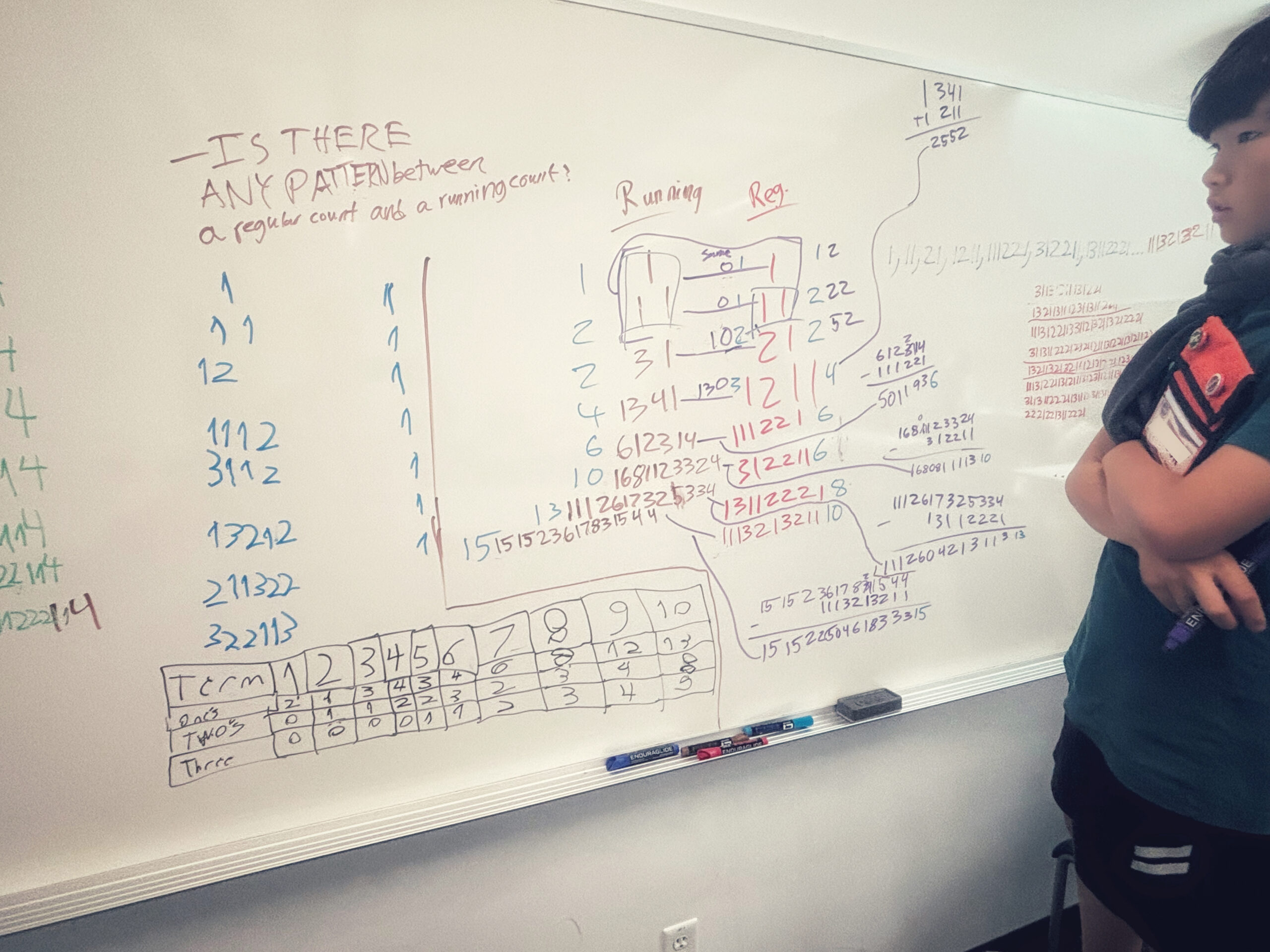
What specifically distinguishes Camp Conway and Camp Sierpinski is our emphasis on helping students experience what it’s like to do mathematics and to become more independent and self-directed thinkers. In Math Explorations, campers spend the final days of class working on an exploratory project of their choosing, which they present to their peers on the last day of camp. It’s always exciting to see what they choose—some continue developing a problem from earlier in the course, while others create their own variations or extensions.
In addition to the academic experience, we’re very intentional about supporting campers as people. For this age group in particular, attending a two-week residential camp can be a big adjustment for both students and parents. Gifted kids often experience asynchronous development—they may be several grade levels ahead in math, but not equally advanced in their social development, emotional maturity, or daily living skills. We place a strong emphasis on camper support and parent communication, which is enabled by having a Camper Support Director as part of each camp’s leadership team.
How do you see math education evolving, and where does NMC fit in that future? What is your long-term vision for NMC?
I see National Math Camps as one part of a much larger ecosystem. Our programs are often a next step for students who have already had a taste of mathematical problem solving and exploration through local math circles, school programs, online classes, or competitions. A multi-week residential camp is a big commitment, and it works best when students arrive already curious and excited about math.
More broadly, I’d love to see more students—from more communities—discover what deep, creative mathematical thinking actually looks like, and have access to high-quality opportunities that help them grow. Programs like ours depend on many other organizations to spark that initial interest, and in turn we aim to deepen it by giving students time, mentorship, and community to explore challenging ideas and develop independence as thinkers.
The U.S. has a remarkably strong math enrichment ecosystem that helps some students reach extraordinary heights—but most families don’t even know this ecosystem exists, and many students never get the chance to experience math as something creative or joyful. My long-term vision for NMC is to help make that ecosystem more visible, more connected, and more accessible, while preserving what makes these experiences special: depth, rigor, and a sense of belonging.
Not every camper will become a mathematician—and that’s not the goal. What matters is that students leave with confidence, curiosity, and a clearer sense of what’s possible, whether they go on to math, science, technology, or any other path.
If you could give one message to every young math student in America, what would it be?
That math is beautiful and creative, and that there’s so much more to it than what’s generally taught in schools. Math is about curiosity—asking your own questions, trying ideas that don’t always work, getting stuck, and then experiencing those incredible “aha” moments when something finally makes sense.