As a math teacher, I’ve worked with many children who are good at math. They pick up new material quickly, apply the methods they’re taught, and bring home strong grades.
But every so often, I meet a student whose mathematical thinking is noticeably different. Instead of simply asking how to solve a problem, they ask questions such as:
“Does this always work?”
“What happens if we change this number?”
“Is there another way to show it?”
Grades and speed show what a child has achieved in school. They don’t always show how the child thinks.
Good at math, or thinking mathematically?
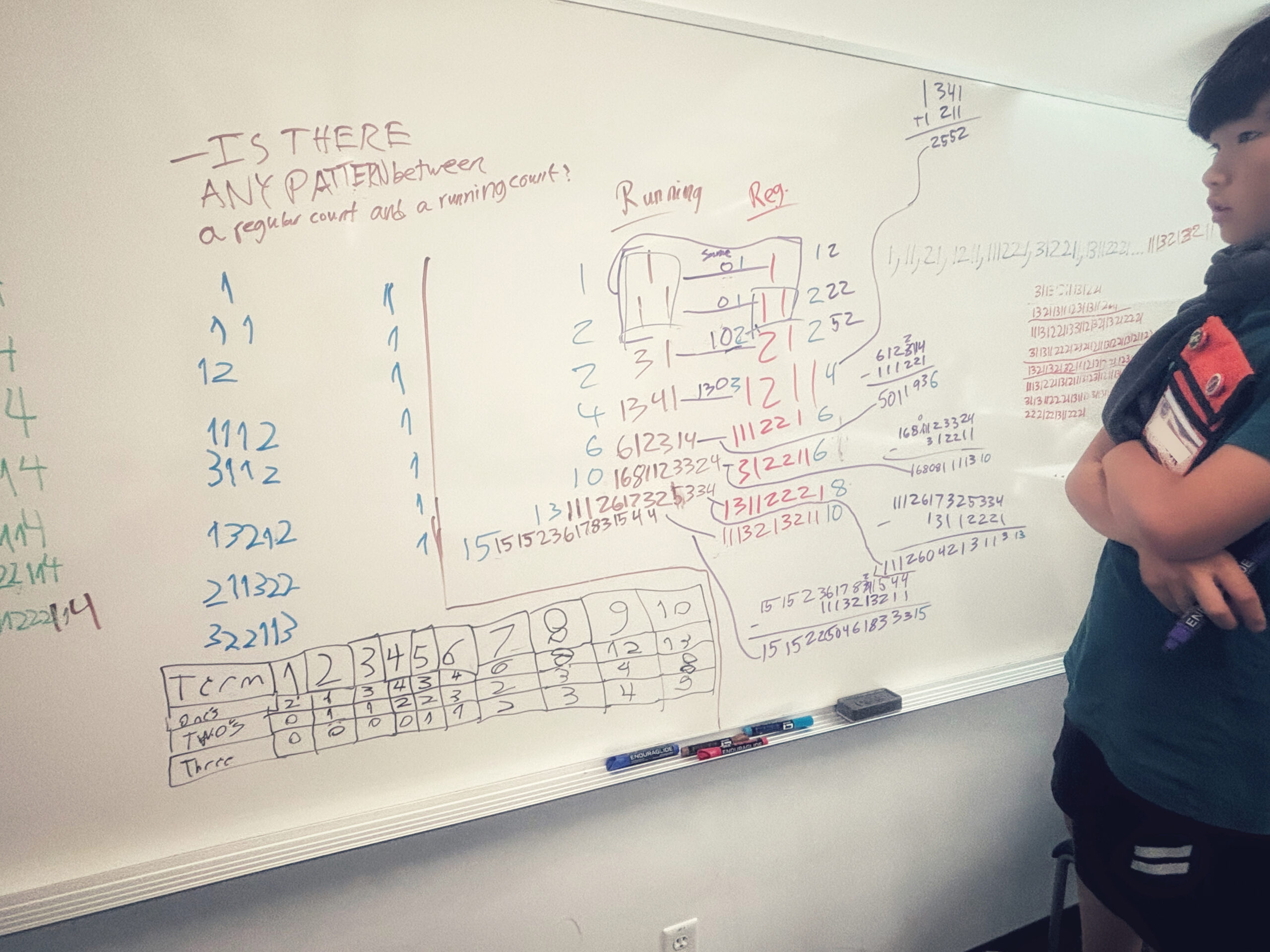
A strong math student learns what is taught, applies it correctly, and gets the right answer. A mathematically talented child often goes further by noticing patterns, connecting seemingly unrelated ideas, and developing approaches nobody showed them.
Think about athletics. One athlete succeeds through practice and disciplined execution. Another shows exceptional speed, coordination, spatial awareness, or an instinctive ability to read the field. That natural aptitude still requires coaching and discipline to develop fully.
Some mathematically talented children are consistent A students, while others show uneven school performance.
What mathematical talent can look like
Parents often expect a mathematically talented child to excel in every part of math class. Real children rarely work that way. A child might grasp an advanced idea while still making arithmetic errors. Another might solve a difficult problem mentally but struggle to explain the steps on paper.
In his book The Psychology of Mathematical Abilities in Schoolchildren, the psychologist V. A. Krutetskii spent years studying the difference between mathematical ability and strong training. His research identified several key characteristics that parents or teachers often observe at home or in the classroom:
Compressed reasoning. Once children internalize a pattern, they may process several steps in one mental leap. This can make it genuinely difficult for them to explain how they reached an answer. Showing work still matters, but they may need help reconstructing and communicating reasoning rather than more instruction on a concept they already understand.
Rapid generalization. Some children see one problem as an example of an entire category. After only one or two examples, they begin asking whether the idea will always work and applying it in situations they have not been taught.
Flexible thinking. They may switch approaches easily when one method fails or solve a problem in a completely unexpected way. What initially looks like “doing it wrong” may reveal original thinking.
Mathematical memory. They may not have unusually strong memories for facts or formulas such as multiplication tables, but they remember relationships, structures, and methods. A child may struggle with rote memorization while retaining the underlying structure of a problem for months.
A preference for elegance. They tend to look for the cleanest, simplest, and shortest path to a solution, even after finding one that works, while typical students give little thought to how elegant or efficient their answer is.
No single characteristic proves that a child is mathematically talented. Look for these ways of thinking repeatedly across different kinds of problems and over time.
What parents may notice early
Mathematical talent can appear before a child receives much formal instruction. Young children may be fascinated by numbers, shapes, puzzles, calendars, board games, or patterns. They may calculate mentally, invent ways to solve problems, or notice numerical relationships during everyday activities.
What stands out is often not how much they already know, but how naturally they look for patterns and structure.
Why recognition matters
Recognizing mathematical talent can help explain why a child’s ability, school performance, and classroom behavior do not always line up. It can also help the child receive an appropriate course, program, or level of support.
One test captures only part of a child’s ability. Performance can be affected by prior educational opportunities, test format, language, anxiety, or learning differences. Some children show their reasoning more clearly in discussion or open-ended work than through a single test or competition result.
A fuller picture may include test results, classroom work, teacher and parent observations, conversations with the child, and examples of the child’s reasoning. Some mathematically talented children are still developing the organizational habits needed to demonstrate their abilities consistently in school. Others are twice-exceptional, meaning they are gifted and also have a disability or learning difference. Their giftedness and challenges may mask each other.
Recognition is only the beginning. The next question is: Now that you see it, what do you do with it?
What parents can do
Observe how your child thinks. Notice the questions they ask, the patterns they see, and how they approach unfamiliar problems.
Collect examples. Save original solutions, independent projects, teacher comments, and work that demonstrates reasoning, not just correct answers.
Learn about assessment. Ask how your school recognizes mathematical talent and whether it considers multiple kinds of evidence.
Advocate with specific requests. Share examples of what your child has mastered and ask about options such as reduced repetition, subject acceleration, or mentorship.
Provide enrichment alongside acceleration. Acceleration offers faster pacing or more advanced material, but it should not replace opportunities for depth, complexity, creativity, and exploration. Mathematically talented children need enrichment even when they are accelerated.
Develop both talent and habits. Mathematical ability does not remove the need for precision, persistence, communication, and practice.
Instead of asking only, “Is my child getting A’s?” or “How far ahead are they?” ask: How does my child think? What kind of challenge do they need now? What support would help them keep growing?
At National Math Camps, we look beyond grades and completed courses. In our admissions process, we pay attention to how students approach unfamiliar problems, recognize patterns, test ideas, and respond when their first approach does not work. Our programs focus on enrichment rather than accelerating students through the standard curriculum. Students explore challenging mathematics in greater depth while developing habits such as persistence, precision, flexible thinking, and clear communication. Our goal is to help mathematically talented children grow without losing what made them love the subject in the first place.